Why I build the website The Letter
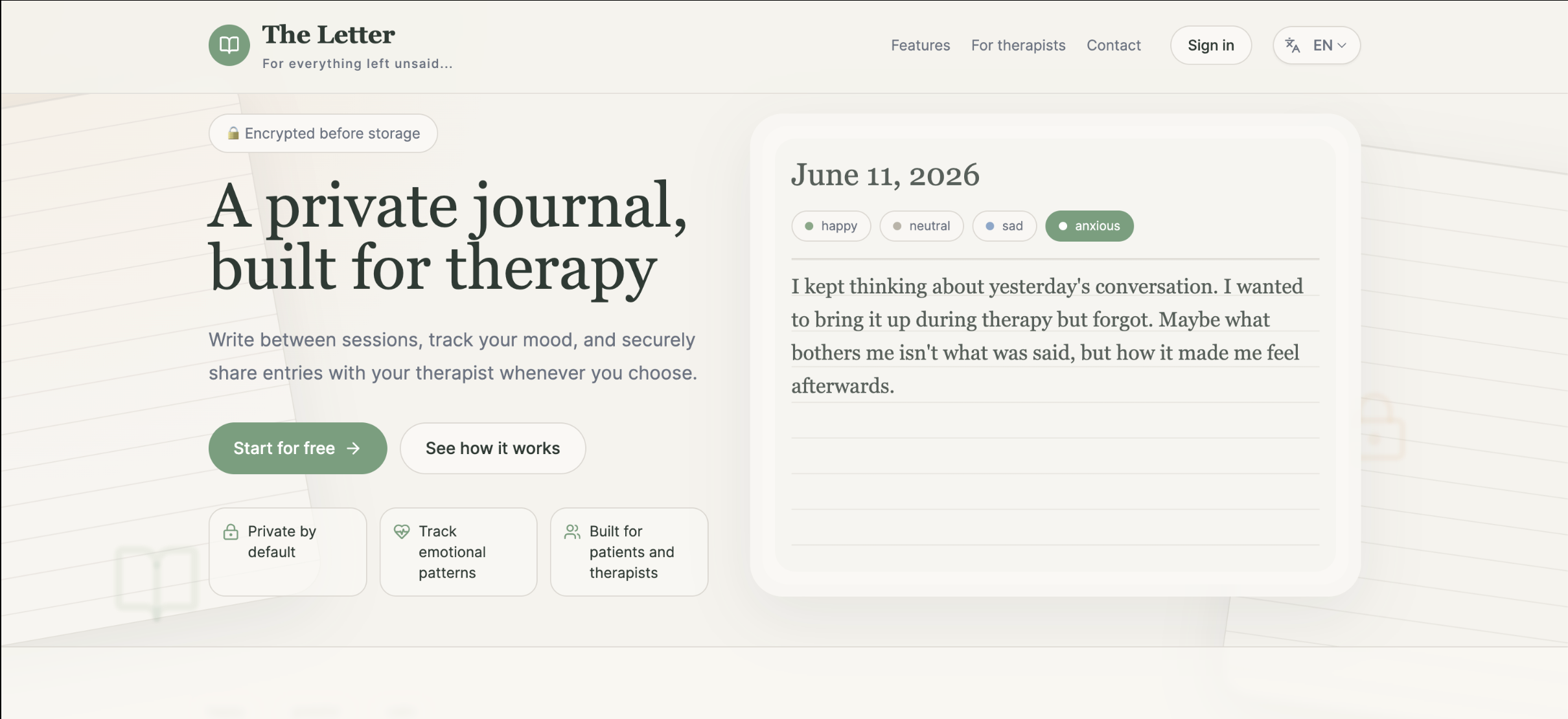
For years, I had the same experience after therapy sessions.
I would leave the office, get back to my normal routine, and then — usually two or three days later — something important would happen.
A realization.
A difficult emotion.
An argument.
A memory.
And almost every time I would think:
“I need to tell my therapist about this.”
By the time the next session arrived, I had forgotten half of it.
Sometimes I remembered that something had happened, but not the details. Other times I forgot entirely.
The result was frustrating. Important events were happening between sessions, yet they never became part of the conversation.
The original idea
My therapist suggested something simple:
Write things down.
Not as a formal journal. Just notes about events, thoughts, emotions, or anything that felt relevant.
The suggestion worked.
The problem was that my notes were scattered everywhere:
- Notes app
- WhatsApp messages to myself
- Random text files
- Pieces of paper
Nothing felt organized.
And sharing those notes with a therapist wasn’t practical either.
As a software engineer, my first instinct was obvious:
What if I built something specifically for this?
Building for a real problem
The goal was never to create another journaling app.
There are already plenty of great journaling products.
Instead, I wanted to solve a very specific problem:
How can patients capture important moments between therapy sessions and make them available when they matter most?
That question became the foundation of The Letter.
The idea evolved into two sides:
For patients
A private space where they can:
- Record thoughts and reflections
- Track moods
- Write about important events
- Keep a timeline of what happened between sessions
For therapists
A way to receive that information when the patient decides to share it.
Not to replace therapy.
Not to replace clinical notes.
Simply to provide more context.
The hardest part
Building the software was not the difficult part.
The difficult part was validating whether therapists would actually find it useful.
As developers, we often assume that because a problem exists, our solution is automatically valuable.
Reality is usually more complicated.
Therapists have different approaches.
Different workflows.
Different concerns about privacy, boundaries, and communication outside sessions.
So the project became less about coding and more about listening.
Every conversation taught me something new.
Some therapists immediately understood the value.
Others raised concerns I had never considered.
Both perspectives helped shape the product.
What happens next?
The Letter is still early.
There are no investors.
No large team.
No marketing department.
Just a problem I personally experienced, and a product I believe can help solve it.
Whether it succeeds or fails, building it has already taught me something important:
The best side projects don’t start with technology.
They start with a problem you genuinely want solved.
Everything else comes later.